
Unpacking recent analysis from Bali Business Review on YouTube, this report highlights how congestion and accessibility directly affect bookings, average daily rates, and seasonal performance for Bali villas. Early indicators point to measurable dips in occupancy and guest satisfaction where traffic barriers reduce convenience and on-site spending.
Hi, I’m Jason, a Business Journalist at Bukit Vista, and I’ll be unpacking analysis from Bali Business Review. Today, we’ll dive into Can Traffic Lower Your Villa’s Revenue? to offer clear, data-driven insights.
Understanding Traffic Impact on Villa Revenue
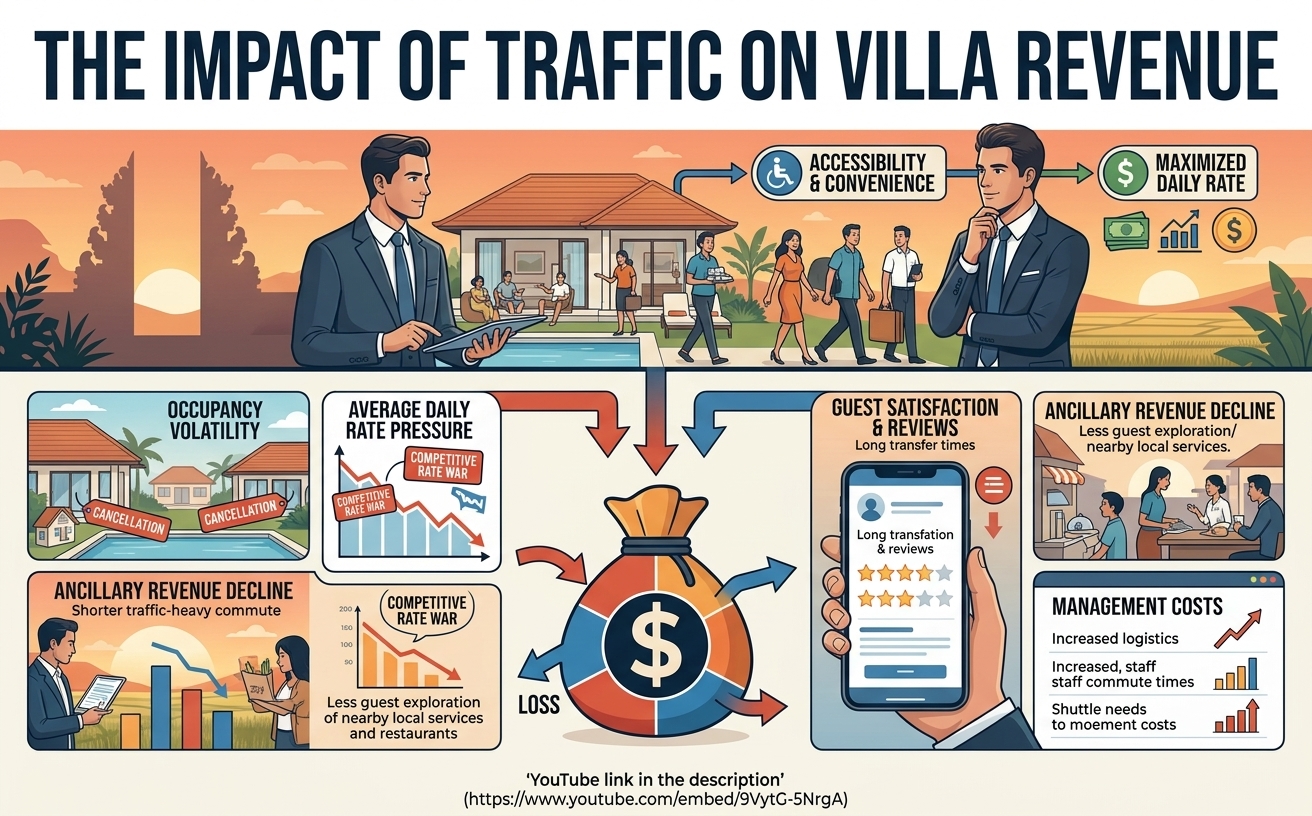
Traffic congestion can erode a villa’s competitiveness by increasing guest commute times, reducing perceived convenience, and lowering repeat-booking rates. When guests spend significant time in transit, discretionary spending on local services, dining, and excursions often falls, lowering ancillary revenue streams for property owners. For Bali property revenue, the cumulative effect of delays and poor accessibility can translate into shorter stays and a lower average daily rate as hosts compete on price to offset inconvenience.
Location and local resources matter: proximity to key attractions, quality of access roads, and availability of parking or shuttle options all shape booking decisions. Villas that advertise seamless transfers, private drivers, or easy access to amenities can mitigate the villa revenue traffic impact by converting accessibility into a premium feature. The embedded YouTube resource is linked above for reference: Watch Video.
Detailed impacts to monitor
- Occupancy volatility: Congested areas often show higher cancellation and no-show rates, especially among short-stay guests who prioritize convenience. Reduced occupancy directly lowers monthly revenue and can push managers to run promotions that compress margins.
- Average daily rate pressure: When multiple properties near traffic bottlenecks compete for the same pool of convenience-seeking travelers, hosts frequently lower rates to maintain bookings, which reduces long-term yield even if occupancy remains stable.
- Ancillary revenue decline: Traffic that discourages guests from exploring nearby restaurants or services reduces on-property F&B and concierge-driven commission opportunities. For many villas, these ancillary streams represent 10-20% of total revenue and are highly sensitive to guest mobility.
- Guest satisfaction and reviews: Lengthy transfer times and unpredictable traffic lead to lower guest ratings on convenience and location, which algorithmically impacts search visibility and future bookings on OTA platforms.
- Management costs: Increased logistics expenses for airport transfers, longer staff commutes, and the need for paid shuttle services raise operating costs, squeezing net returns even if gross revenue appears unchanged.
- Seasonal amplification: In peak season, short delays can cascade into greater dissatisfaction and lost bookings, while in shoulder seasons, traffic-related disadvantages become an even stronger booking deterrent.
- Mitigation levers: Investing in guest transfer services, clear itinerary guidance, dynamic check-in options, or partnerships with local guides can neutralize some negative impacts of traffic on Bali property revenue.
Estimating Revenue with Bukit Vista’s Calculator
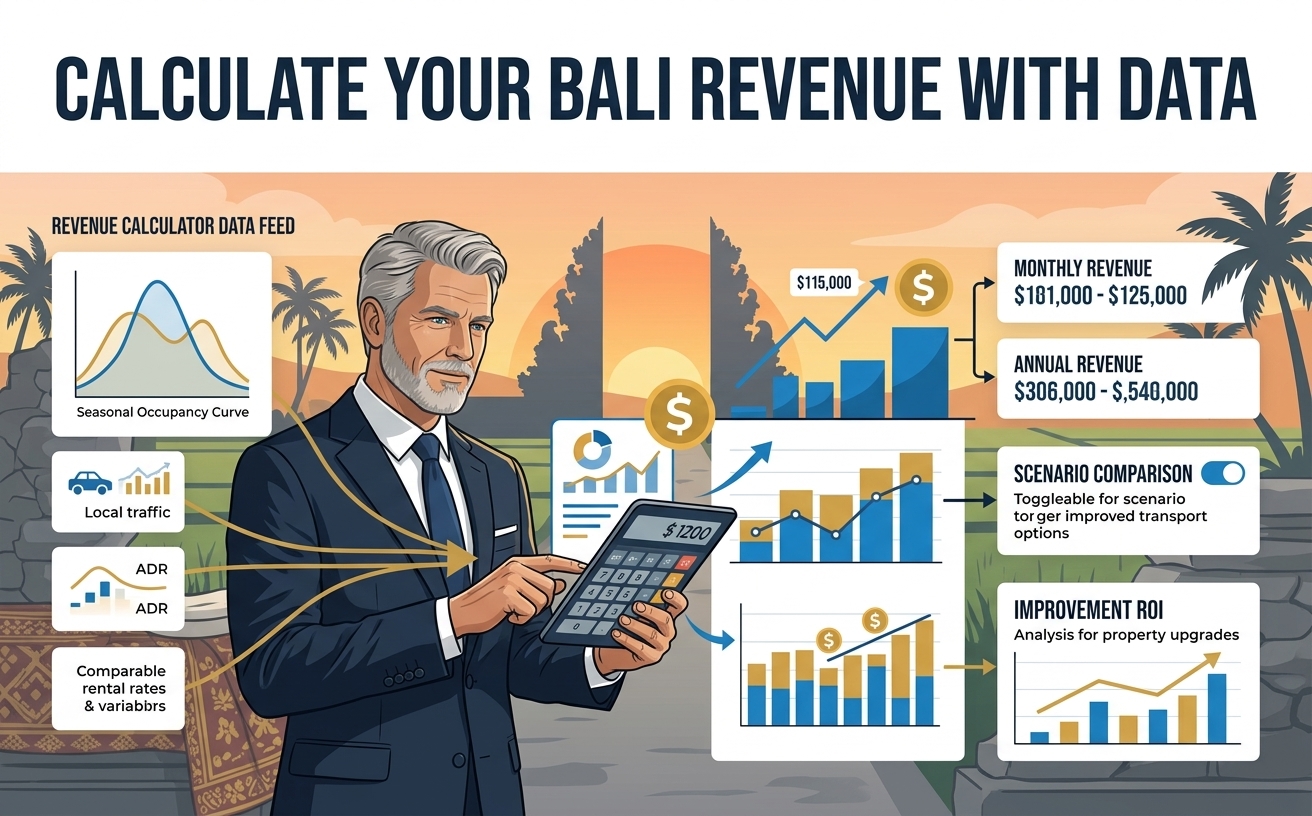
Bukit Vista’s Revenue Calculator is designed to convert real Bali market data into a straightforward revenue forecast so owners can quantify how factors like traffic and location affect earnings. The tool integrates live market trends, occupancy patterns, and comparable property performance to provide an evidence-based estimate of potential Bali property revenue under different operating scenarios. For owners concerned about villa revenue traffic impact, the calculator models variations in occupancy and ADR tied to accessibility and local constraints.
Using the Bukit Vista calculator delivers personalized, actionable outputs: forecasts for monthly and annual revenue, scenario comparisons (e.g., with and without shuttle service), and insights into which property improvements yield the highest returns. Because the model is grounded in current Bali demand signals and property-level inputs, results reflect the local supply-demand balance rather than generic tourism assumptions.
How the Bukit Vista calculator adds value
- Data-driven benchmarks: The tool uses recent Bali market data, including neighborhood demand, seasonal occupancy curves, and comparable rental rates, so your estimate aligns with real market behavior.
- Location sensitivity: Inputs for access times, proximity to attraction hubs, and local transport options allow the calculator to quantify the villa revenue traffic impact specifically for your address, not just a generic neighborhood average.
- Personalized scenarios: Owners can toggle variables—improved transfers, enhanced amenities, or price adjustments—to see the projected effect on Bali property revenue and determine the ROI of mitigation measures.
- Market trends analysis: The platform surfaces trend indicators such as rising demand corridors and shifting guest preferences, enabling proactive pricing and marketing decisions that counteract traffic-related downturns.
- Instant forecast and next steps: The calculator provides immediate revenue ranges and concrete recommendations—whether to adjust rates, invest in guest transport, or target a different guest segment—making it a practical tool for short- and medium-term planning.
- Direct link to planning: Property owners can use the output to inform listings, seasonal pricing, and operational budgets for better alignment with real Bali booking behavior.
Key Takeaways
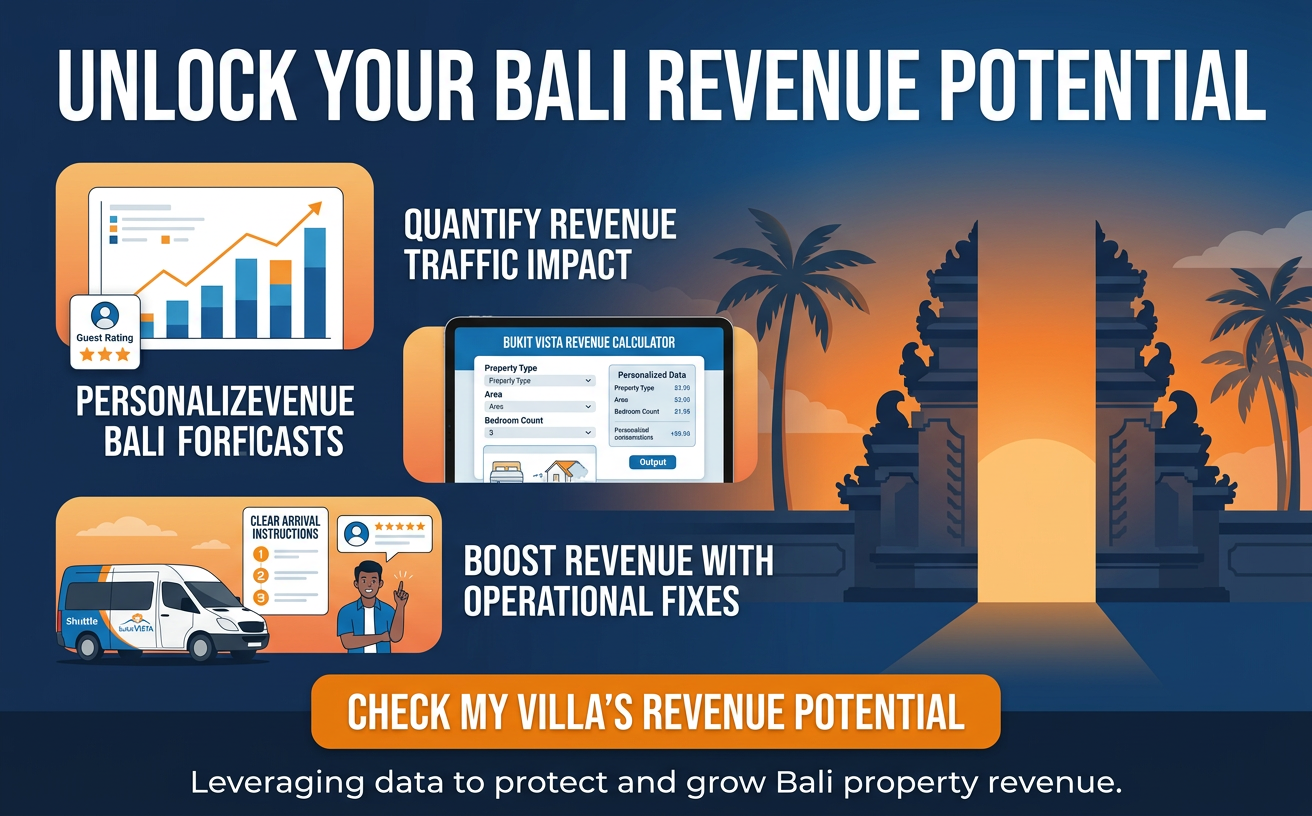
- Traffic and accessibility materially affect bookings, ancillary spend, and guest ratings—key drivers of Bali property revenue.
- Quantify the villa revenue traffic impact for your property using evidence-based inputs rather than assumptions.
- Bukit Vista calculator provides localized, personalized forecasts that help prioritize investments like transfer services or relocation of listing focus.
- Small operational fixes (shuttles, clear arrival instructions) can produce outsized revenue gains by improving convenience and reviews.
Final word: Traffic is not just a nuisance—it is a revenue variable that owners can measure and manage. Leveraging the Bukit Vista calculator to convert market data into a revenue plan allows owners to make targeted investments in accessibility, pricing, and guest experience that protect and grow Bali property revenue.
Jason, Business Journalist at Bukit Vista
You’re a property owner? Wondering What Could Your Bali Villa Really Earn?
Get a data-driven revenue projection based on your property type, area, and bedroom count. Discover your villa’s true earning potential in Bali.